RaritanLenape.org > Raritan Lenape History / Footprint > 1756 Pennsylvania Scalp Bounty
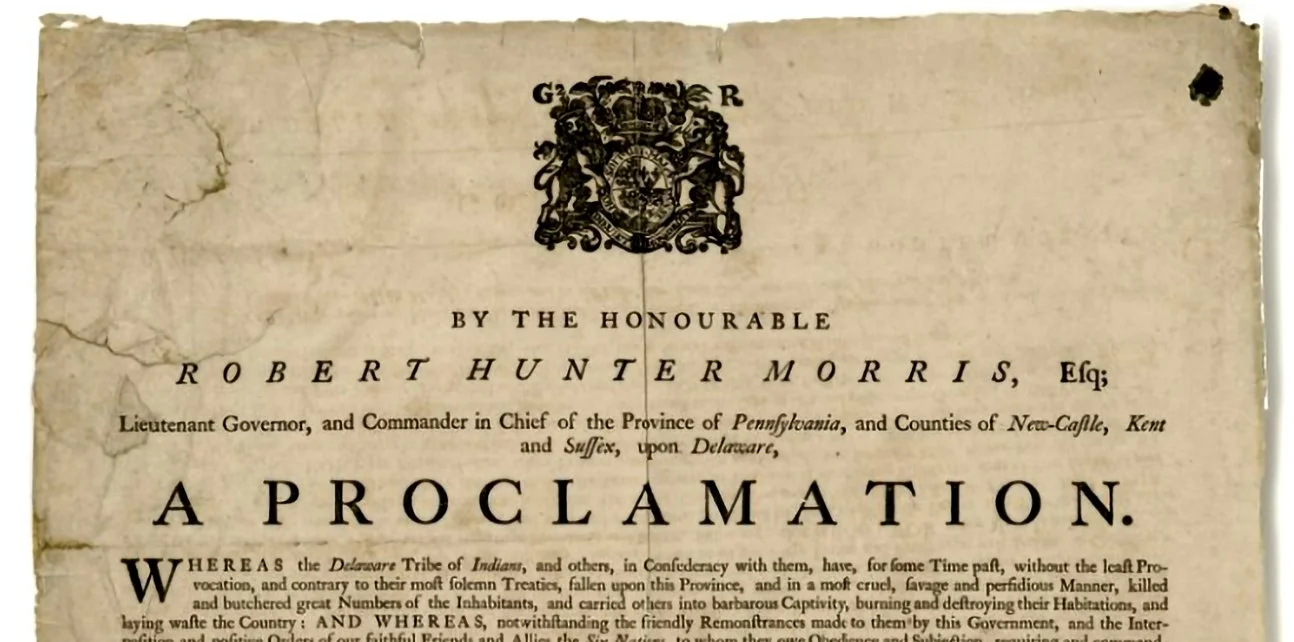
The Price of a Lenape Life
By 1756, relations between the Lenape and Pennsylvania had collapsed into war.
For decades, Lenape communities had watched European settlement push steadily westward. Land disputes, including the notorious Walking Purchase of 1737, deepened resentment, while colonial expansion forced many Lenape from places their families had known for generations. When the French and Indian War erupted, some Lenape warriors turned against Pennsylvania.
The fighting was brutal. Lenape war parties attacked frontier settlements, killing settlers and taking captives. Pennsylvania responded with military force and, on April 14, 1756, something more chilling.
The colonial government put a price on Lenape lives.
Lieutenant Governor Robert Hunter Morris issued a proclamation offering rewards for Lenape people declared enemies of Pennsylvania:
A man over twelve, captured alive: 150 Spanish dollars.
His scalp: 130.
A woman captured alive: 130.
Her scalp: 50.
A boy under twelve was worth 130 dollars if brought in alive.
The scalp had become more than a trophy. It was proof of death that could be exchanged for money from the colonial government.
Pennsylvania attempted to distinguish between enemies and Native people who remained at peace with the colony. The proclamation exempted Lenape and others who had placed themselves under colonial protection. But on a violent frontier, there was an obvious and terrifying problem:
A scalp could not tell anyone whose head it had come from.
The proclamation was no unofficial call for revenge. It was a government document, issued under Pennsylvania's Great Seal. The money came from £60,000 appropriated by the Assembly for “His Majesty’s use.” It was printed in Philadelphia by Benjamin Franklin and David Hall, during the reign of King George II.
Its language leaves little room for interpretation. Pennsylvania's government had turned killing into a transaction, assigning different monetary values to men, women, and children.
And at the bottom of the proclamation placing a price on Lenape scalps appeared three words:
“GOD SAVE THE KING.”