RaritanLenape.org > Lenape People / Stories > Turtle, Turkey & Wolf
The Lenape Clans
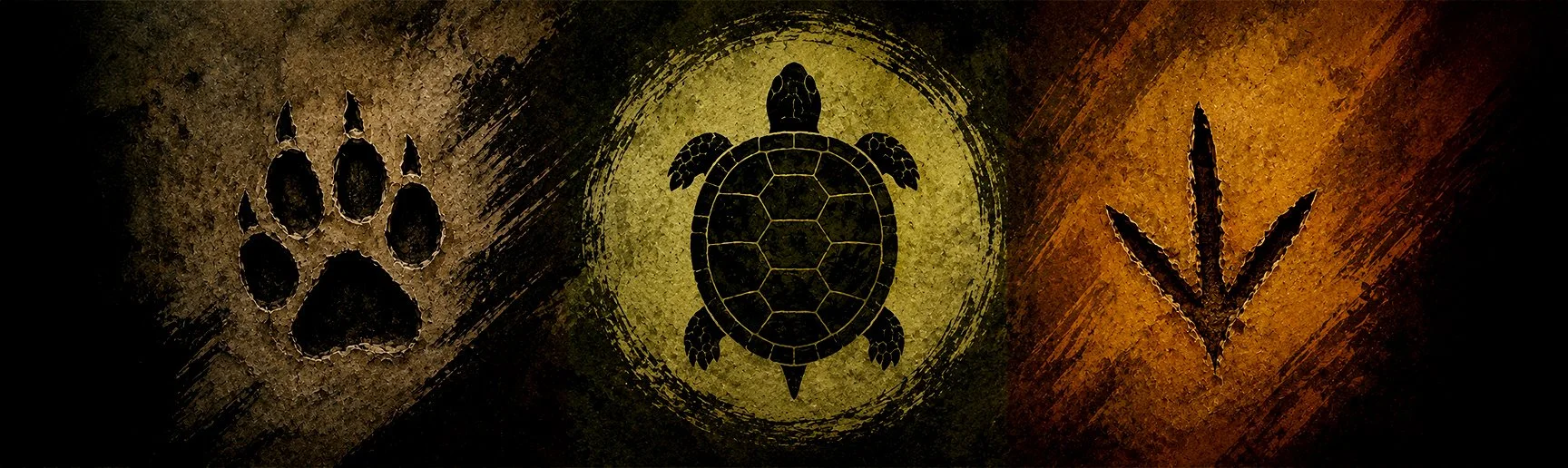
Turtle, Turkey, and Wolf were more than symbols. They identified the great kinship groups into which Lenape people were born. Clan identity followed the mother's line, passing from mother to child. Their Lenape names were Turtle (Pùkuwànku), Turkey (Pële), and Wolf (Tùkwsit). Through these connections, people who might live far apart could still understand themselves as members of the same extended family.
Turtle - Pùkuwànku
Turtle held an important place in Lenape culture. Its significance extended beyond the animal that gave the clan its name. In an account preserved by the Delaware Nation, the Creator guided their ancestors to a hill as a great flood covered the land. The hill revealed itself as the Great Turtle, Tahkox, which rose with them upon its back and carried them safely until the waters receded. The story connects Turtle with survival, the earth, and Turtle Island, an Indigenous name for North America.
Turtle imagery also appears prominently in Lenape ceremonial life. Turtle-shell rattles, for example, played an important role in the Big House Ceremony, where they accompanied songs, dances, prayers, and the recounting of visions. Today, the Delaware Nation in Oklahoma identifies itself with the Pùkuwànko, or Turtle Clan.
Turkey - Pële
The name Pële is recorded as meaning “does not chew,” referring to the way a turkey swallows its food. This meaning appears in nineteenth-century accounts of the Lenape language.
Wild turkeys, abundant throughout the region, were important to Lenape life. They provided food, while their feathers could be fashioned into warm mantles and other coverings. Even the stiff, hairlike “beard” from a turkey's breast was used in men's roach headdresses.
Turkey also crossed the boundary between everyday and ceremonial life. In a 1921 account of the Munsee Big House Ceremony, Harrington described turkey-wing fans being used to sweep and ritually purify the earthen floor, clearing away both dirt and what he called “evil influences.” The men who performed the sweeping served as ceremonial attendants.
The importance of Turkey can also be seen in this closeness to daily life. The same animal that provided nourishment and warmth also supplied materials used in dress and ceremony. Its many uses reflect how closely everyday life, the natural world, and ceremonial practice were connected in Lenape culture.
Wolf - Tùkwsit
Wolf was known as Tùkwsit, a name associated with the wolf's rounded foot or paw. In Lenape accounts, Wolf appears as a traveler, moving across the land and covering great distances. One account recorded from a Lenape elder describes Wolf as a benefactor who helped the people in the distant past, giving the animal a positive place in Lenape storytelling.
Wolf became particularly associated with the Munsee-speaking Lenape of northern Lenapehoking. Older historical accounts sometimes went so far as to identify Munsee with the Wolf Clan. The relationship was more complicated: Munsee communities included Turtle and Turkey families as well, although historical evidence suggests that Wolf families were especially prominent among them. This close association helps explain why Wolf and Munsee were sometimes treated as nearly interchangeable.
Wolf also left its mark on the landscape. The Lenape name Tùkwsitu, meaning “place of Wolf Clan people,” survives in modern-day Tuxedo, New York, within the northern Lenape homeland. Forms including Tucseto and Tuxseto were recorded in a 1735 land survey, preserving the Lenape clan association in the place-name we know today.
Families Within the Clans
Within Turtle, Turkey, and Wolf was an even more intricate network of families. Historical accounts describe numerous smaller kinship groups within the three great clans, although writers have not always used the same terms for them. They have variously been described as families, lineages, clans, and subclans.
In the nineteenth century, Lewis Henry Morgan recorded twelve such divisions within each of the three larger groups, although two of the Turtle divisions were said to have disappeared. Among those he recorded were Yellow Tree within Wolf, Little Turtle within Turtle, and Big Bird within Turkey. Lenape people interviewed by later researchers remembered many of these same names, although they did not always describe them specifically as subclan names.
These smaller family connections formed part of a much larger system of kinship. Marriage followed rules that helped prevent people considered close relatives from marrying, although exactly how those rules worked may have varied among Lenape communities and over time. Kinship extended far beyond the immediate household. Clan and family connections helped Lenape people understand who was related, where they belonged, and the responsibilities they carried toward one another.
Clan and Geography
Clan identity was sometimes associated with geography, but the connection was not simple. Historical writers often linked Wolf with the Munsee-speaking Lenape of the northern homeland, Turtle with the Unami farther south, and Turkey with the Unalachtigo of the southern region. These associations have sometimes led to maps showing three distinct clan territories. The Raritan River, for example, is often described as a dividing line between Wolf to the north and Turtle to the south.
The reality was more complicated. Turtle, Turkey, and Wolf families could live within the same broader regions, and members of different clans lived within the same Lenape communities. Clan identity should therefore not be confused with geographic and linguistic groupings such as Munsee, Unami, and Unalachtigo. The Lenape world did not divide neatly into three clan territories.
Clan could turn a stranger into a relative. A Lenape person traveling far from home could meet someone of the same clan and recognize a bond reaching beyond village or immediate family. That connection brought recognition, but also responsibility. Clan and the smaller family divisions within it helped shape marriage, relationships, obligations, and a person's place among other Lenape people.
To be Turtle, Turkey, or Wolf was to know that family could extend far beyond the people you knew by name.