RaritanLenape.org > Lenape People / Stories > Lenape Place Names
YOU MAY ALREADY SPEAK A LITTLE LENAPE AND NOT EVEN KNOW IT.
Every day, millions of New Jersey residents travel through towns, cross rivers, and pass mountains whose names preserve traces of the languages spoken here long before European settlement.
Raritan. Watchung. Hackensack. Manasquan. Passaic.
These names appear on highway signs, school buildings, maps, and mailing addresses. Most people give them little thought. Yet many preserve Indigenous names for waterways, landscapes, and communities that existed centuries before the towns themselves.
The landscape was renamed by settlers, but not every Indigenous name disappeared.
A Map That Still Speaks Lenape
Many Lenape place names originally described something important about a location: a mountain, a bend in a river, a gathering place, or a feature that helped travelers recognize the land.
Others identified Indigenous communities or individuals. As Dutch and English settlers recorded these names, they changed spellings, altered pronunciations, and sometimes misunderstood their meanings.
That is why some familiar place names have several competing translations. In certain cases, their original meanings may never be known with confidence.
Here are some of the most interesting examples.
Raritan: The Name at the Heart of This Website
The Raritan River gave its name to towns, neighborhoods, schools, and an entire region of New Jersey.
The name appears in seventeenth-century Dutch records in several spellings, including Raretangh. It was associated with Indigenous people living in the river valley and the surrounding country.
The precise meaning of Raritan remains uncertain. Various translations have been proposed, but no single explanation has been conclusively established.
What we do know is that the name existed long before the modern towns that carry it. It preserves a connection to the Indigenous communities whose lives were intertwined with the river.
Watchung: The Mountains Had a Name
The Watchung Mountains rise above the Raritan Valley in a series of distinctive ridges.
Watchung is commonly interpreted as a Lenape-derived expression meaning “on the mountain” or “at the hill.” Related forms appear in early colonial descriptions of the landscape.
The name reminds us that these ridges were familiar landmarks long before modern roads crossed them. They helped define the geography through which Indigenous people traveled, hunted, and maintained connections between communities.
Piscataway: A Name with a Complicated History
Piscataway is one of Middlesex County's oldest and most recognizable names.
Although often presented as a Lenape place name, its history is more complicated. The colonial township was named in connection with settlers from Piscataqua in New England, rather than being securely documented as the original Lenape name for the New Jersey location.
The name's deeper origins have been associated with Indigenous language traditions in New England.
Piscataway illustrates why a place name that sounds Indigenous should not automatically be identified as a local Lenape word.
Metuchen: Remembering an Indigenous Leader
Unlike many place names that describe geography, Metuchen is commonly associated with the name of an Indigenous leader recorded by early European settlers.
Historical accounts connect the name to a seventeenth-century Raritan-area leader whose name appears in varying forms, including Matochshegan.
Although the exact linguistic derivation is uncertain, the name preserves a possible personal connection to the Indigenous leadership of the region.
Today, thousands of people use the name Metuchen without realizing that it may recall a person who lived here centuries before the borough existed.
Hackensack: A River, a Community, and a Name
Hackensack was associated with an Indigenous community of northeastern New Jersey and with the river that still carries the name.
Early Dutch records preserve several versions, including Hackinkesack and related spellings.
Different interpretations have been proposed for its meaning, some referring to the shape or character of the river and surrounding landscape.
Whatever its precise translation, the name preserves the historical presence of Indigenous communities in the Hackensack and lower Hudson valleys.
Passaic: A Name That Followed the River
The Passaic River winds through northern New Jersey, connecting upland valleys with the lowlands near Newark Bay.
The name is Indigenous in origin, although historical interpretations of its meaning vary. Some traditional explanations associate it with a valley or flowing water.
Like Raritan, Passaic became both a river name and the name of a modern city and county.
Manasquan: A Name from the Coastal Landscape
Manasquan, on the Monmouth County coast, preserves a name associated with the area's Indigenous past.
One interpretation connects the name with a place for gathering grasses or reeds, reflecting the marshes and waterways of the coastal environment.
Other linguistic explanations have been offered, reminding us that even familiar names may have more than one possible origin.
Navesink: A View Across the Land
The Navesink name survives in the river, highlands, and communities near Sandy Hook and Raritan Bay.
One interpretation, offered by Delaware elder and language speaker Lucy Parks Blalock, connects the name with a place where one can see from afar.
That interpretation is especially evocative in the Navesink Highlands, where elevated ground provides sweeping views of the surrounding coastline.
The name also recalls the Navesink communities whose history is closely connected to the broader Raritan Bay region.
Secaucus: A Place Associated with Snakes
Secaucus is commonly interpreted as an Indigenous name meaning “place of snakes.”
The name is generally associated with the marshy Meadowlands environment, where snakes and other wildlife were once abundant.
Today, it survives amid highways, rail yards, and industrial development, a reminder of a very different landscape.
Peapack: Where Waters Meet
Peapack, in the Somerset Hills, is commonly given a Lenape-derived interpretation associated with water or the meeting of waters, although historical explanations differ.
The name belongs to a landscape of streams, hills, and fertile valleys that supported Indigenous communities long before the arrival of colonial farms and country estates.
Matawan: A Name with More Than One Meaning
Matawan is another Indigenous-derived name whose exact meaning remains debated.
Historical interpretations have associated it with the meeting of waterways or features of the surrounding land.
The name survives in a region connected to Raritan Bay and the broader network of Lenape coastal communities.
Musconetcong: An Ancient River Name
The Musconetcong River flows through northwestern New Jersey before joining the Delaware River.
Its Indigenous-derived name appears in numerous historical spellings, and proposed meanings vary.
The river was part of a wider landscape of waterways, valleys, and travel routes known to Indigenous communities long before the establishment of modern Hunterdon and Warren counties.
More Indigenous Place Names Across New Jersey
The names above are only a small sample. Many others survive throughout the state, sometimes in altered forms.
Northern New Jersey: Mahwah, Ramapo, Ho-Ho-Kus, Weehawken, Totowa, Pequannock, Pompton, Wanaque, Weequahic, Communipaw, and Acquackanonk.
Central New Jersey: Rahway, Navesink, Matawan, Manalapan, Cheesequake, Assunpink, and Wickatunk.
Western and Northwestern New Jersey: Allamuchy, Lopatcong, Pohatcong, Hopatcong, Kittatinny, and Manunka Chunk.
Southern and Coastal New Jersey: Absecon, Cinnaminson, Mantoloking, Tuckahoe, and Alloway.
Not all these names come from the same Lenape dialect, and some have disputed linguistic origins. Others reached their modern forms through Dutch or English spelling conventions.
The original pronunciations were often quite different from the ones heard today.
What About Manhattan?
Across the Hudson River, the name Manhattan also preserves an Indigenous linguistic history.
The name is commonly associated with Mannahatta, an early recorded form connected to the Munsee-speaking Indigenous landscape of the island. Its exact derivation remains debated.
The survival of the name is particularly striking given how thoroughly the island's geography has been transformed.
Why These Names Matter
A place name can survive long after the landscape around it has changed.
Rivers have been dammed. Forests have been cleared. Wetlands have been filled. Indigenous villages gave way to colonial farms, industrial towns, suburbs, and cities.
Yet names spoken centuries ago remain part of everyday life.
They are not simply unusual words on a map. They are fragments of Indigenous history preserved in plain sight.
And the languages behind them are not merely relics of the past. Today, Lenape nations and language preservation initiatives continue working to document, teach, and revitalize Munsee and Unami.
The next time you cross the Raritan, drive through Watchung, or see a sign for Hackensack or Manasquan, consider the history carried in that name.
New Jersey's map still speaks the languages of its first peoples. We just need to learn how to listen.
Historical Sources and Further Reading
For a deeper dive on this subject
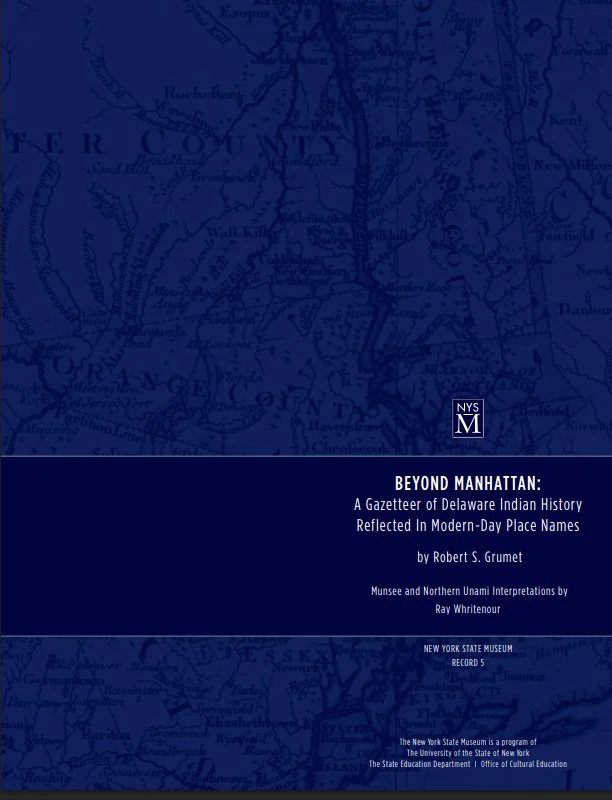
BEYOND MANHATTAN: A GAZETTEER OF DELAWARE INDIAN HISTORY REFLECTED IN MODERN-DAY PLACE NAMES by Robert S. Grumet. Munsee and Northern Unami Interpretations by Ray Whritenour