RaritanLenape.org > Lenape People / Stories > Spirituality, Ceremony & Healing
Spirituality, Ceremony and Healing
For the Lenape, the spiritual world was woven into everyday life. The Creator, Kishelëmukònk, stood at the center of a world in which human beings lived in relationship with animals, plants, the earth, water, and spiritual powers. Hunting, planting, gathering medicine, dreams, healing, and ceremony could all carry spiritual meaning. There was no sharp boundary between the sacred and the ordinary.
A World of Relatives
The Lenape did not understand people as standing apart from nature. They lived within a world of relationships, some expressed in the language of family. Earth could be understood as Mother; the Sun and Moon as Elder Brothers; Thunder beings as Elder Brothers; and fire as Grandfather. Animals and plants had spirits of their own, and particular places, waters, stones, and other parts of the landscape could possess spiritual power.
These were more than poetic names. They expressed a world in which humans depended upon other living and spiritual beings and owed them respect. A plant gathered for medicine or an animal taken for food was not simply a resource. People were participants in a larger living world.
Dreams, Visions and Manitou
Dreams and visions could bring knowledge and guidance. Some were understood as encounters with spiritual beings or powers and could remain important throughout a person's life.
Young people might seek a vision through fasting, hardship, and time alone, particularly as they approached adulthood. A vision might bring a song, guidance, or a relationship with a manitou, a spiritual being or power. Such experiences were deeply personal, but could later become part of ceremonial life.
The Big House
The Big House Ceremony was one of the most important Lenape ceremonies recorded historically. Held over a number of days in a large ceremonial house, it brought people together for prayer, singing, dancing, feasting, and the sharing of visions. Participants gave thanks to the Creator and prayed for the well-being of the people. Songs connected with dreams and visions could be performed as turtle-shell rattles accompanied singing and dancing.
Ceremony engaged nearly every sense. People heard songs, drums, and turtle-shell rattles, watched dancers move around the ceremonial space, smelled burning tobacco and cedar, and gathered around the fire. The ceremonial path was swept with turkey-feather fans, while cedar was placed on the fire for purification.
Cedar, Tobacco and Purification
Cedar held an important place in Lenape purification. Cedar leaves or needles could be placed on hot coals or a fire, and the smoke used to cleanse people, homes, and ceremonial spaces. Nora Thompson Dean, one of the great twentieth-century keepers of Lenape knowledge, described burning cedar and fanning its smoke over people and through homes and ceremonial spaces for purification.
Cedar was also burned during the Big House Ceremony and after a death. Tobacco carried its own spiritual importance. It could be smoked or offered during ceremony and offered when medicinal plants were gathered. In these settings, tobacco was more than an everyday substance: it helped express prayer, respect, and the relationship between people, the Creator, and the spiritual world.
Healing and Medicine
Healing drew upon an extensive knowledge of the natural world. Roots, leaves, bark, berries, and other materials were prepared as teas, washes, poultices, and other remedies. Different plants were used for different purposes, and knowledge varied from person to person and family to family. Early observer David Zeisberger noted that both Lenape men and women possessed medicinal knowledge, although some individuals knew considerably more than others.
Some of the plants recorded in later Lenape medicinal traditions are still common throughout Lenapehoking. Sassafras was prepared as a spring tonic; birch was used for coughs and colds; sumac for ailments including toothache; and cattail for wounds and other conditions. Sweat bathing was another important practice, used in connection with health, cleansing, and purification. Some men and women became particularly respected for their abilities as herbalists and healers.
Medicine could have a spiritual dimension as well as a practical one. Medicinal plants were understood as gifts placed in the world by the Creator, Kishelëmukònk, and gathering them could involve prayer and ritual. Later Lenape accounts describe a person searching for the needed plant, placing tobacco beside the first one encountered as an offering, and then gathering other plants of the same kind. The medicine was not simply the plant itself. How it was approached, gathered, prepared, and used could matter as well.
This knowledge could be deeply personal. Some remedies were learned within families; others could come through dreams or visions. Lenape traditions distinguished people particularly knowledgeable in herbal remedies from medicine people whose healing practices also engaged more directly with spiritual powers. Illness, in other words, was not always understood as something affecting the body alone.
For the Lenape, healing could bring together observation, experience, plants, family knowledge, dreams, ceremony, and relationships with the spiritual world. Medicine was not simply something taken when a person became sick; it belonged to a much larger understanding of the relationship between people and the living world around them.
A Tradition Under Pressure
Colonization placed these traditions under enormous pressure. Christian missionaries sought to convert Lenape communities and opposed ceremonies and beliefs they considered incompatible with Christianity. Displacement scattered families and communities, making ceremonies increasingly difficult to maintain. Some practices disappeared, others changed, and Christianity became important within many Lenape families.
Older understandings did not simply vanish. Lenape spiritual life changed and adapted as communities survived removal and dispersal.
What survives in the historical record is also incomplete. Missionaries and anthropologists recorded many beliefs and ceremonies through the assumptions of their own times. Lenape people had no obligation to explain every ceremony or piece of spiritual knowledge to outsiders. Some knowledge remained within families and communities, where it belonged.
Across centuries of displacement and profound change, relationships with the Creator, family, community, ancestors, and the living world remained powerful threads connecting generations.
A Deeper Dive
Published in 1921, M. R. Harrington’s Religion and Ceremonies of the Lenape preserves an extraordinary window into Lenape spiritual life at a time when many traditional practices were rapidly disappearing. Drawing heavily on conversations with Lenape people including Julius and Minnie Fouts, Harrington recorded ceremonies, beliefs, songs, sacred objects, and firsthand memories that might otherwise have been lost.
Lenape spirituality today takes many forms
Some Lenape people continue or have renewed traditional beliefs and ceremonies, while others practice Christianity, often while maintaining a strong Lenape identity and connection to their culture. For many, these traditions can exist side by side.
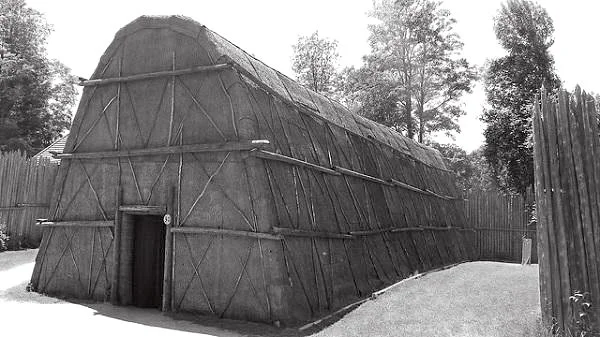
Lenape Big House, looking southwest,” ca. 1908–1910, near Dewey, Oklahoma. The Smithsonian Collection. Photographed by M. R. Harrington 1921 Religion and Ceremonies of the Lenape.