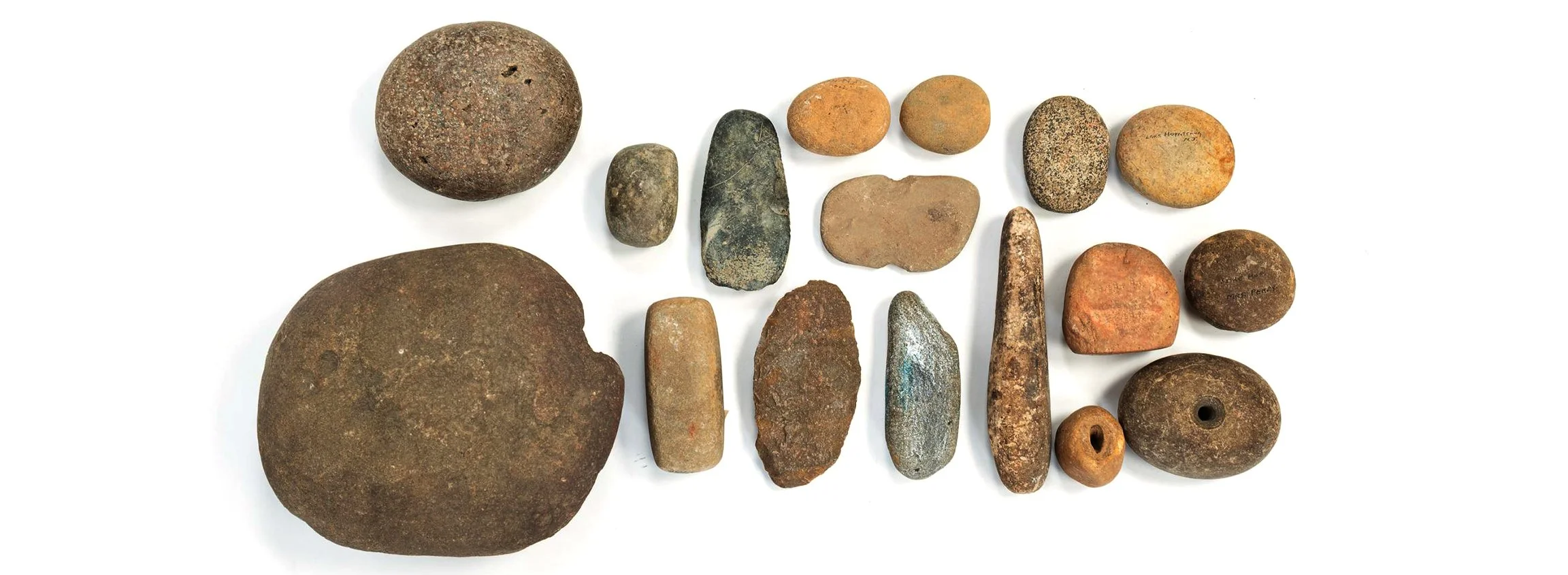
FOUND A LENAPE ARTIFACT? OWN AN ARTIFACT OR COLLECTION?
Understanding, Preserving & Respecting Lenape Heritage
An arrowhead discovered in a backyard. A pottery fragment found along a riverbank. A collection of ancient objects passed down through generations.
Each may hold a piece of New Jersey's Indigenous history - and sometimes, the most valuable information isn't the object itself, but where it was found. That location could help identify a previously unknown settlement, confirm evidence of an ancient campsite, or add an important piece to the history of the Lenape homeland.
These were once objects made and used by real people. Tools they hunted and worked with. Pottery they crafted and cooked in. Possessions that were part of everyday life, often passed through the generations. Some may also hold cultural meaning for today's Lenape nations.
Whether you've discovered something unusual, inherited a family collection, or spent years collecting, you can help preserve the history of the people who lived here long before European settlement.
ARROWHEADS, STONE TOOLS & EVERYDAY OBJECTS
Arrowheads, spear points, stone tools, pottery fragments, and other everyday objects are among the most commonly encountered traces of New Jersey's ancient inhabitants.
These objects offer clues about how people hunted, prepared food, made tools, and lived on the land. Some date back thousands of years, long before the historically documented Lenape communities.
Ordinary artifacts such as arrowheads, stone tools, and pottery fragments are not subject to federal repatriation requirements under NAGPRA when lawfully held by private individuals. Other laws may apply depending on where and how an object was obtained.
IF YOU DISCOVER A POSSIBLE LENAPE ARTIFACT
Whenever possible, leave the object where you found it.
Photograph it in place, record its location privately, and avoid digging or disturbing the surrounding soil.
For guidance, consider contacting a qualified archaeologist, the New Jersey State Museum, or the New Jersey Historic Preservation Office.
Collecting or disturbing archaeological materials may be restricted or prohibited, especially on public or protected lands. Always respect property rights and applicable laws.
IF YOU OWN AN ARTIFACT OR COLLECTION
Many individuals and families have preserved collections of stone tools, pottery, and other archaeological objects for generations. Even modest collections may contain valuable information about the history of the Raritan Valley and surrounding region.
You do not have to give up an ordinary, lawfully held artifact or collection to make a meaningful contribution to understanding Lenape history.
Consider documenting:
Where and when each object was originally discovered, if known.
Photographs, measurements, and identifying information.
Family records, previous owners, and associated historical documents.
Original labels, maps, or notes that might help establish an object's history.
Qualified archaeologists, museums, and historical organizations may be able to help identify and document these materials.
Interested Lenape nations may also wish to learn about particular collections, especially those connected to their ancestral homeland. Their interests and priorities should guide any consultation.
If requesting identification assistance or specialized cultural guidance, respect Lenape representatives' time, knowledge, and expertise, including appropriate compensation.
A collection can remain privately owned while its history becomes part of a greater understanding of the Lenape homeland.
HUMAN REMAINS, BURIALS & FUNERARY OBJECTS
If you encounter possible human remains or a burial site, stop immediately and contact local police.
Do not touch, move, collect, or disturb anything, including objects that may be associated with a burial.
Authorities will arrange the appropriate investigation and, when Native American ancestry is suspected or established, involve qualified specialists and potentially affiliated Tribal nations.
Human remains are not artifacts. They are the remains of people who deserve dignity, protection, and respect. They are someone’s ancestoral grandfathers or grandmothers. Burial sites and funerary objects also deserve special consideration, with the appropriate Lenape nations having a central voice in decisions about their care and treatment.
The federal Native American Graves Protection and Repatriation Act (NAGPRA) establishes procedures for returning Native American human remains, funerary objects, sacred objects, and objects of cultural patrimony held by covered museums and federal agencies. Consultation with culturally affiliated Tribal nations is an essential part of that process.
If you already possess possible human remains or funerary objects, seek appropriate professional guidance and explore consultation with the relevant Lenape nations before making decisions about their handling or disposition.
Learn more about NAGPRA — National Park Service
WORKING WITH TODAY'S LENAPE NATIONS
The Lenape people have not disappeared. Their nations and communities continue today, carrying forward their histories, traditions, and cultural knowledge.
Not every Lenape nation will have the same interests or priorities regarding archaeological collections. Some may welcome information about particular discoveries, opportunities for research, or collaboration with museums and collectors. Others may have different priorities.
The important thing is to ask, listen, and let the Lenape nations determine what is meaningful to them.
Individuals wishing to donate or voluntarily return objects can begin by contacting an interested Lenape nation and sharing available information about the collection.
In some circumstances, a nation and a qualified museum or other institution may agree to an arrangement in which the nation owns a collection while the institution provides professional care. Such arrangements depend on the wishes of the nation, the institution's agreement, and applicable legal requirements.
Voluntary return is one possible outcome of a conversation - not an expectation for every ordinary artifact or collection.
PRESERVING HISTORY THROUGH COOPERATION
Private collectors, archaeologists, museums, historical organizations, and Lenape nations can all contribute to a fuller understanding of the region's Indigenous history.
Sometimes that means documenting a collection, sharing photographs or research, or arranging for objects to be studied. Sometimes it means exploring new relationships or opportunities for collaboration.
RaritanLenape.org does not accept, authenticate, appraise, purchase, or handle artifacts, and does not represent any Lenape nation. However, we can help you make connections with appropriate representatives or institutions.