RaritanLenape.org > Raritan Lenape History / Footprint > Manhattan for $24: A Myth That Refuses to Die
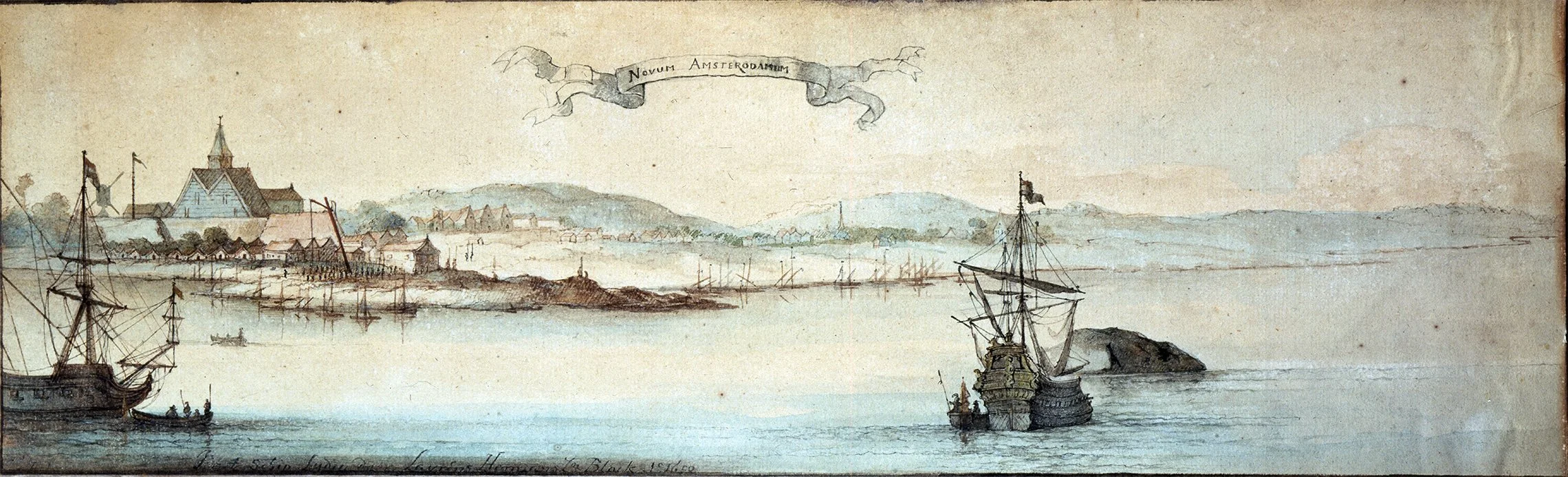
You have probably heard the story: the Dutch bought Manhattan from the Lenape for $24 worth of beads and trinkets. It is one of America's most memorable historical anecdotes. But this all-too-familiar story is not supported by the surviving evidence.
Long before the Dutch arrived, the Lenape knew the island by a name often rendered Manaháhtaan, one of several historical forms associated with Manhattan. It was not an empty wilderness waiting to be claimed, but part of a living Indigenous homeland, with communities, waterways, trails, and generations of human history. The story of Manhattan did not begin with a purchase. It began with the people who already called it home.
An extraordinary island changes hands for almost nothing. The newcomers get the bargain of the centuries. The people whose homeland it was are remembered for supposedly giving it away. But the familiar version tells us far more than the surviving evidence. New York City's Landmarks Preservation Commission calls it a legend and suggests that the Lenape probably understood the arrangement as something closer to a temporary agreement to use land. What sounds like a simple sale becomes much less certain when we look at the record.
One Letter, Centuries of Retelling
The story begins with a real letter. On November 5, 1626, Pieter Schaghen wrote from Amsterdam, passing along news brought by a ship returning from New Netherland. Between reports about colonial life and shipments of animal skins, he recorded that the Dutch had purchased Manhattan from its Indigenous inhabitants for the value of 60 guilders.
Schaghen had not witnessed the exchange. He did not name the Indigenous participants, describe the negotiations, or list the goods exchanged. There is no mention of beads and trinkets.
As the Smithsonian's National Museum of the American Indian explains, the record does not tell us what the Native participants understood the agreement to mean, or even whether there was a mutually understood agreement.
The Dutch claim survives. The Lenape explanation does not appear beside it.
That silence matters. A report that someone purchased an island is not the same as a record showing that everyone agreed to its permanent surrender.
The Price Tag Came Later
The famous $24 was not written into the record in 1626. According to the Netherlands' National Archives, John Romeyn Brodhead converted the reported 60 guilders into $24 in 1844, more than two centuries later. That calculation became the memorable price attached to the story.
Repeating it as though someone handed over twenty-four modern dollars makes the exchange sound absurdly cheap. New York City's archaeological account questions the conversion and suggests that the goods may instead have served as a ceremonial gift confirming an agreement.
The price tag draws our attention. The more important question is what those goods were understood to secure.
Sharing Land Is Not Surrendering
Imagine welcoming someone onto land your community has occupied for generations. You accept gifts, establish a relationship, and agree that the newcomers may live or trade there.
Have you also agreed that they now control the entire territory and may decide its future without you?
The Smithsonian's educational resource, Did Native People Really Sell Manhattan?, asks readers to consider differences in how Native people and the Dutch understood land and exchange. It describes Native trade as a way to obtain valued goods, build alliances, and strengthen relationships.
An agreement about sharing land could carry a very different meaning from an outright sale.
This does not mean Indigenous people lacked rules about land or the ability to negotiate. It means we should not assume that European property rules were the only possible understanding of an agreement.
New York City's Landmarks Preservation Commission suggests that the Lenape probably understood the arrangement as temporary, more like a lease.
We cannot reconstruct the exact conversation. But we should not fill that uncertainty with the assumption that the Lenape knowingly gave away their homeland for a handful of objects.
Even the Dutch Government Archives Challenges the Myth
The institution that preserves Schaghen's letter also challenges the story built around it.
The Netherlands' National Archives explicitly describes the familiar purchase narrative as a myth. Its educational account emphasizes that the letter presents a secondhand Dutch interpretation.
It also explains the harm in the traditional telling: it makes Dutch ownership appear to have received unquestioned Lenape approval while portraying Indigenous people as naïve or easily deceived.
Historian Jaap Jacobs, writing separately for the National Archives, places the letter within the arguments Europeans used to support their territorial claims. Reports of purchase, settlement, and cultivation helped establish the Dutch case for possession.
The letter is valuable evidence. Understanding why it was written makes it more valuable still.
Who Had the Right to Decide?
Nearly two centuries later, the U.S. Supreme Court gave legal force to a system that placed European claims above Indigenous freedom to control land.
In Johnson v. M'Intosh (1823), the Court ruled that private purchases directly from Indigenous nations could not establish title recognized by American courts. Chief Justice John Marshall relied on the Doctrine of Discovery, which gave European powers superior territorial claims while recognizing a restricted Indigenous right of occupancy.
His opinion described Indigenous peoples as "fierce savages" and recounted how European rulers considered "civilization and Christianity" compensation for taking their independence. Marshall expressed reservations about those justifications, yet upheld the system built upon them.
The case did not decide whether Manhattan had been sold. Its connection is broader: it shows how the newcomers' understanding of ownership could become the rule that courts enforced.
That makes the missing Lenape account especially important.
The question was never simply what changed hands. It was also who had the power to decide what the exchange meant.
A Homeland Deserves More Than a Price Tag
There is evidence that the Dutch reported an exchange in 1626. There is no comparable record establishing that the Lenape understood it as the permanent surrender described in the familiar story.
We do not need to invent certainty to recognize the problem. The surviving account is incomplete. The dollar figure came later. The portrayal of people foolishly trading away their homeland rests on assumptions that reputable institutions now challenge.
For generations, the supposed bargain has made the story easy to remember. A more honest telling asks us to remember the people, too.
Before it became New Amsterdam, before its shores were transformed into the world's most famous skyline, the island was Manaháhtaan, part of the ancestral homeland of the Lenape.
Its history began long before the Dutch arrived. Its people deserved more than a footnote in someone else's story. And its worth could never be measured by a price tag of $24.
Sources and Further Reading:
Smithsonian National Museum of the American Indian: The Schaghen Letter
Smithsonian Native Knowledge 360°: Did Native People Really Sell Manhattan?
New York City Landmarks Preservation Commission: “Purchase” of Manhattan
Jaap Jacobs, Netherlands’ National Archives: When Did It All Begin?
U.S. Supreme Court: Johnson v. M’Intosh, 21 U.S. 543 (1823) - particularly pages 573–574 and 589–592.